
Cancer Drugs: 30% Trade Margin Cap on 137 Medicines
A PIB factsheet of 6 November 2026 says NPPA capped trade margins on 137 non-scheduled anti-cancer medicines at 30% of MRP under Paragraph 19 of DPCO 2013, with lower prices from 9 November 2026.
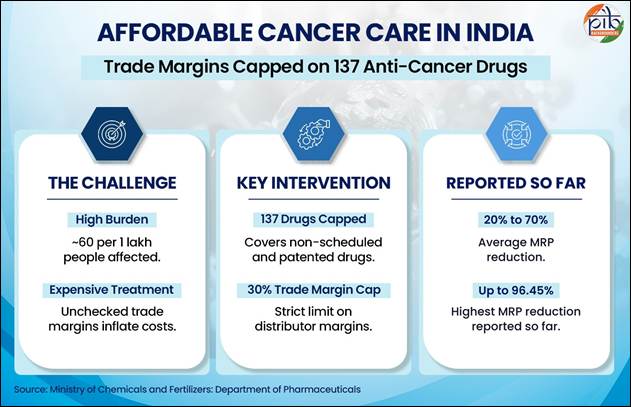
The National Pharmaceutical Pricing Authority capped trade margins on 137 non-scheduled anti-cancer medicines at 30% of the MRP, in an order of 17 October 2026. The lower prices apply from 9 November 2026 in retail and hospital pharmacies across India. NPPA used Paragraph 19 of the Drugs (Prices Control) Order, 2013, after States and patients flagged wide gaps between procurement price and MRP.
What did NPPA do to cancer drug prices in 2026?
By its order of 17 October 2026, NPPA capped the trade margin on 137 non-scheduled anti-cancer medicines, including patented ones, at 30% of the MRP. New MRPs are worked out from the average distributor price of March 2026. The revised prices take effect on 9 November 2026.
Affordable, quality cancer care for every family is a priority for the Government of India.
PIB factsheet, Ministry of Chemicals and Fertilizers (6 November 2026)
What Happened?
NPPA invoked Paragraph 19 of the Drugs (Prices Control) Order, 2013 on the recommendation of an Expert Committee under the Directorate General of Health Services. The order is S.O. 5690(E) of 17 October 2026. It brings 137 non-scheduled anti-cancer drugs, including patented ones, under trade margin rationalisation.
Trade margin is the gap between the price a manufacturer charges a stockist or distributor and the MRP a patient pays, excluding GST. The Order caps this margin at 30%. The cap applies to every dose and form, and to single or combination products. GST is added on top.
Manufacturers must recalculate MRPs from their average distributor price of March 2026. Medicines already cheaper than the new limit cannot be made dearer. Companies must report new prices to NPPA, publish the cuts in newspapers, post them online and tell all retailers and hospitals.
By 4 November 2026, 70 companies had reported revised MRPs covering 1,136 stock keeping units of 120 drugs. Reported cuts average 20% to 70%, and the highest is 96.45%. A firm that fails to cut prices must deposit the overcharged amount with interest.
Companies may not cut production without permission. They must give six months’ notice before stopping a medicine completely. Consumers can check prices on the NPPA website and the Pharma Sahi Daam mobile app.
Why It Matters
Cancer treatment is a leading cause of medical impoverishment, and many of these drugs are patented or sit outside price ceilings. A margin cap reaches them without fixing a ceiling price drug by drug. It also helps patients who pay out of pocket, because insurance cover under AB-PMJAY does not reach everyone.
The savings figure is an estimate based on past sales volume, not on actual patient bills. The factsheet does not say how many reported SKUs are stocked in small-town chemists. Companies had reported 120 of the 137 drugs by 4 November 2026, so the full effect is still unknown.
Concept Behind the News: Scheduled and Non-Scheduled Drugs
DPCO 2013 sorts medicines into two groups. Scheduled medicines are in the First Schedule, which is the National List of Essential Medicines (NLEM) 2022. The Government fixes a ceiling price for each. NLEM 2022 lists 388 medicines, of which 63 are anti-cancer drugs.
Non-scheduled medicines are monitored, not capped. Under Paragraph 20, a manufacturer may raise the MRP by no more than 10% in twelve months. Paragraph 19 is the extraordinary power to fix or change the price of any drug in the public interest. A 2019 pilot of Trade Margin Rationalisation covered 42 non-scheduled anti-cancer drugs, and the 2026 order widens it to 137.
Syllabus Connection
- GS-II (Governance and Social Justice): health policy, regulators and welfare schemes
- GS-III (Economy and S&T): pricing policy, intellectual property and pharmaceuticals
- Prelims (Current Affairs and Economy): DPCO, NPPA, NLEM, Ayushman Bharat
- CDS (General Knowledge): government schemes and Indian economy
- UPPSC PCS Prelims and Mains (General Studies and Essay): health schemes and Ayushman Bharat
PYQ Connection
UPSC Prelims 2022
Question: With reference to Ayushman Bharat Digital Mission, consider the following statements: 1. Private and public hospitals must adopt it. 2. As it aims to achieve universal health coverage, every citizen of India should be part of it ultimately. 3. It has seamless portability across the country. Which of the statements given above is/are correct?
- 1 and 2 only
- 3 only
- 1 and 3 only
- 1, 2 and 3
Answer: 3 only
Option (b) is correct. The Ayushman Bharat Digital Mission is voluntary, so statements 1 and 2 are wrong. Statement 3 is right: its digital health ID and records are meant to work across the country. It sits beside AB-PMJAY, the insurance pillar named in the PIB factsheet.
UPSC Prelims 2019
Question: Consider the following statements: 1. According to the Indian Patents Act, a biological process to create a seed can be patented in India. 2. In India, there is no Intellectual Property Appellate Board. 3. Plant varieties are not eligible to be patented in India. Which of the statements given above is/are correct?
- 1 and 3 only
- 2 and 3 only
- 3 only
- 1, 2 and 3
Answer: 3 only
Option (c) is correct. Only statement 3 is right: plant varieties are not patentable in India. Statement 1 is wrong because a biological process to create a seed is not patentable. Statement 2 was wrong when asked, as the Intellectual Property Appellate Board then existed. Patents give monopoly pricing power, which is why drug price control matters.
CDS 2020
Question: Which one of the following is not a feature of the Ayushman Bharat Scheme?
- There is no cap on family size and age.
- The scheme includes pre- and post-hospitalization expenses.
- A defined transport allowance per hospitalization will also be paid to the beneficiary.
- The scheme provides a benefit cover of ₹ 10 lakh per family.
Answer: The scheme provides a benefit cover of ₹ 10 lakh per family.
Option (d) is correct. The scheme gives cover of ₹5 lakh per family per year, not ₹10 lakh. The PIB factsheet repeats the ₹5 lakh figure for AB-PMJAY. The other three options are genuine features.
UPPSC Prelims 2020
Question: With reference to 'Ayushman Bharat Yojana' which of the following statement(s) is/are correct? 1. This Yojana provides free health insurance of Rs. five lakh per person. 2. The expenses incurred in this Scheme (Yojana) is shared between the Centre and State in 60 : 40 ratio. Select the correct answer from the codes given below. Codes:
- 1 only
- 2 only
- Both 1 and 2
- Neither 1 nor 2
Answer: 2 only
Option (b) is correct. Statement 1 is wrong because the ₹5 lakh cover is per family, not per person. Statement 2 is right: PM-JAY is a Centrally Sponsored Scheme with costs shared between the Centre and States in a 60:40 ratio.
Visual Explanation: How Many Cancer Drugs Are Regulated
Anti-cancer drugs under each price regulation window
| NLEM 2022 ceiling price | 63 |
|---|---|
| TMR pilot 2019 | 42 |
| TMR order Oct 2026 | 137 |
Scheduled vs non-scheduled medicines under DPCO 2013
| Feature | Scheduled | Non-scheduled |
|---|---|---|
| Where listed | First Schedule (NLEM 2022) | Outside the First Schedule |
| Price tool | Government-fixed ceiling price | Monitoring; 10% yearly MRP rise under Paragraph 20 |
| Extraordinary power | Paragraph 19 can change a fixed price | Paragraph 19 can fix or cap price in public interest |
| Cancer example | 63 anti-cancer drugs in NLEM 2022 | 137 drugs under the 30% margin cap |
Connect the Dots
- States and patients raise the gap between procurement price and MRP of cancer drugs.
- An Expert Committee under DGHS recommends trade margin rationalisation.
- NPPA invokes Paragraph 19 of DPCO 2013 in its order of 17 October 2026.
- Margins on 137 non-scheduled drugs are capped at 30% of MRP, based on March 2026 distributor prices.
- Revised prices apply from 9 November 2026, with public notice and price displays.
- AB-PMJAY, NP-NCD clinics and Ayushman Arogya Mandirs cover treatment and screening.
Read More
Read More
- PIB factsheet: Cheaper Cancer Medicines (Official source for every figure in this article)
- TB-Free India: Cases Down 21% as JOSH Squads Join Fight (Earlier DORI article on public health delivery)
Exam Takeaway
- NPPA order S.O. 5690(E) of 17 October 2026: 30% trade margin cap on 137 non-scheduled anti-cancer drugs; effective 9 November 2026.
- Legal basis: Paragraph 19 of DPCO 2013 (extraordinary powers); Paragraph 20 allows a 10% yearly MRP rise.
- NLEM 2022: 388 medicines, 63 anti-cancer; released 13 September 2022; first created in 1996.
- Early results: 70 companies, 120 drugs, 1,136 SKUs, up to 96.45% cut, ₹3,357.49 crore estimated savings.
- AB-PMJAY: ₹5 lakh per family a year; 1,961 procedures in 27 specialties.
Exam Angle
Prelims can test NPPA, DPCO 2013, NLEM and Ayushman Bharat details. Mains can ask whether price control hurts innovation or helps access. Argue that margin caps cut costs fast, but supply continuity and monitoring of compliance decide whether patients truly gain.
Possible Question
Practice Question
Question: With reference to the regulation of medicine prices in India, consider the following statements: 1. The Drugs (Prices Control) Order, 2013 is issued under the Essential Commodities Act. 2. Paragraph 19 of the Order allows the Government to fix or change the price of a drug in extraordinary circumstances in the public interest. 3. The 2026 NPPA order caps the trade margin on 137 anti-cancer drugs at 50% of the MRP. Which of the statements given above is/are correct?
- 1 and 2 only
- 2 and 3 only
- 1 and 3 only
- 1, 2 and 3
Answer: 1 and 2 only
Statements 1 and 2 are correct. Statement 3 is wrong: the cap is 30% of the MRP, not 50%.