Agrivoltaics: Centre Plans a Scheme for Solar Above Farms
The Centre is drawing up a central sector scheme to help States adopt agrivoltaics, where elevated solar panels let farmers keep growing crops underneath.
The Ministry of New and Renewable Energy (MNRE) is drawing up a central sector scheme to help States adopt agrivoltaics. These are solar panels raised above working farms, so crops grow underneath. MNRE Secretary Santosh Kumar Sarangi announced it in New Delhi on 19 October 2026. It may stand alone or sit inside the coming PM-KUSUM 2.0.
What is agrivoltaics?
Agrivoltaics means installing solar panels at a height above farmland, so the same land produces both crops and electricity. Farmers keep cultivating underneath while earning from power sold to the grid. In India, elevated panels cost about 25% more than ground-mounted ones. The Centre plans a scheme to cover this extra cost.
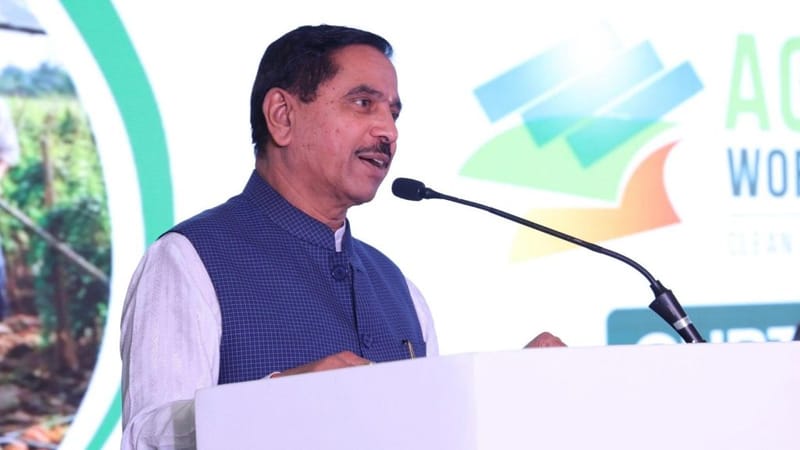
We do not have to choose between crop and solar plant; we can do both at the same time
Pralhad Joshi, Union Minister for New and Renewable Energy, curtain-raiser for the 7th Agrivoltaics World Conference (9 September 2026)
What Happened?
At a press briefing on 19 October, Sarangi said the scheme would give States an initial incentive. The ministry has not decided whether it will be standalone or part of PM-KUSUM 2.0. The conference is expected to draw over 1,500 participants from India and 24 countries. An agriphotovoltaics policy document and a regulatory compendium are expected to be released there.
Pilots run with the Indian Agricultural Research Institute show leafy vegetables, fruits and flowers suit the shade under panels. Sugarcane, wheat and rice do not. Hindustan Times has reported over 40 such pilots across the country. In September, Minister Pralhad Joshi said the next phase of PM-KUSUM would include a dedicated agrivoltaics component.
Why It Matters
India holds about 18% of the world's population on 2.4% of its land, so ground-mounted solar competes with farming. Agrivoltaics lets one acre yield crops, power sales and diesel savings. That suits small and marginal farmers, who are over 85% of India's farmers. The catch is cost and crop choice: staple cereals do poorly under panels.
Decentralised solar added 16.3 GW last year, per Joshi: 7.6 GW under PM-KUSUM and 8.7 GW of rooftop solar. About 29 lakh farm pumps have been solarised. India added 55.29 GW of non-fossil capacity in the year, towards its 500 GW target for 2030.
Concept Behind the News: PM-KUSUM and Central Sector Schemes
PM-KUSUM (Pradhan Mantri Kisan Urja Suraksha evam Utthaan Mahabhiyaan) brings solar power to farms. Per MNRE, it aimed to add 34,800 MW by March 2026 with ₹34,422 crore of central support. It has three parts. Component A funds small solar or renewable plants of 500 kW to 2 MW on farmers' land, including stilt-mounted plants.
Component B funds 14 lakh standalone solar pumps. Component C solarises 35 lakh grid-connected pumps, including whole agricultural feeders. A central sector scheme, like the one MNRE now plans, is funded fully by the Centre. A centrally sponsored scheme is run by States with shared Centre-State funding.
Syllabus Connection
- GS-II (Governance): Government schemes, their design and Centre-State funding
- GS-III (Economy): Infrastructure, energy and renewable power
- GS-III (Agriculture): Farm incomes, land use and e-technology for farmers
- GS-I (Geography): Distribution of energy resources and land use
PYQ Connection
UPSC Prelims 2020
Question: With reference to solar water pumps, consider the following statements: 1. Solar power can be used for running surface pumps but not for submersible pumps. 2. Solar power can be used for running centrifugal pumps but not the ones with piston. Which of the statements given above is/are correct?
- 1 only
- 2 only
- Both 1 and 2
- Neither 1 nor 2
Answer: Neither 1 nor 2
Option (d) is correct. Solar power can run both surface and submersible pumps, and both centrifugal and piston pumps. PM-KUSUM Component B funds such standalone solar pumps for farms.
UPSC Prelims 2024
Question: Consider the following: 1. Battery storage 2. Biomass generators 3. Fuel cells 4. Rooftop solar photovoltaic units How many of the above are considered "Distributed Energy Resources"?
- Only one
- Only two
- Only three
- All four
Answer: All four
Option (d) is correct. Battery storage, biomass generators, fuel cells and rooftop solar are all distributed energy resources: small sources close to the user. Farm agrivoltaic plants fall in the same group.
UPSC Prelims 2016
Question: 'Net metering' is sometimes seen in the news in the context of promoting the
- production and use of solar energy by the households/consumers
- use of piped natural gas in the kitchens of households
- installation of CNG kits in motor-cars
- installation of water meters in urban households
Answer: production and use of solar energy by the households/consumers
Option (a) is correct. Net metering credits households and other consumers for surplus solar power fed to the grid. Agrivoltaic farmers would similarly earn by selling power to distribution companies.
UPSC Prelims 2025
Question: Consider the following statements about ‘PM Surya Ghar Muft Bijli Yojana’: I. It targets installation of one crore solar rooftop panels in the residential sector. II. The Ministry of New and Renewable Energy aims to impart training on installation, operation, maintenance and repairs of solar rooftop systems at grass-root levels. III. It aims to create more than three lakhs skilled manpower through fresh skilling, and up-skilling, under scheme component of capacity building. Which of the statements given above are correct?
- I and II only
- I and III only
- II and III only
- I, II and III
Answer: I, II and III
Option (d) is correct. PM Surya Ghar targets one crore rooftop solar households, trains local technicians and aims to skill over three lakh people. Rooftop solar added 8.7 GW last year, alongside 7.6 GW under PM-KUSUM.
UPSC Prelims 2014
Question: With reference to technologies for solar power production, consider the following statements: 1. 'Photovoltaics' is a technology that generates electricity by direct conversion of light into electricity, while 'Solar Thermal' is a technology that utilizes the Sun's rays to generate heat which is further used in electricity generation process. 2. Photovoltaics generates Alternating Current (AC), while Solar Thermal generates Direct Current (DC). 3. India has manufacturing base for Solar Thermal technology, but not for Photovoltaics. Which of the statements given above is/are correct?
- 1 only
- 2 and 3 only
- 1, 2 and 3
- None
Answer: 1 only
Option (a) is correct. Photovoltaics turns light directly into electricity, while solar thermal uses heat. Photovoltaics produces direct current, not alternating current, and India makes PV equipment too. Agrivoltaics uses photovoltaic panels.
UPSC Prelims 2018
Question: With reference to solar power production in India, consider the following statements: 1. India is the third largest in the world in the manufacture of silicon wafers used in photovoltaic units. 2. The solar power tariffs are determined by the Solar Energy Corporation of India. Which of the statements given above is/are correct?
- 1 only
- 2 only
- Both 1 and 2
- Neither 1 nor 2
Answer: Neither 1 nor 2
Option (d) is correct. India was not the third-largest maker of silicon wafers, and solar tariffs are set by competitive bidding and regulators, not by SECI. The agrivoltaics cost gap is a tariff issue of this kind.
UPSC Prelims 2017
Question: The term ‘Domestic Content Requirement’ is sometimes seen in the news with reference to
- Developing solar power production in our country
- Granting licences to foreign T.V. channels in our country
- Exporting our food products to other countries
- Permitting foreign educational institutions to set up their campuses in our country
Answer: Developing solar power production in our country
Option (a) is correct. Domestic Content Requirement rules made solar projects use Indian-made cells and modules. Scheme-funded solar, including PM-KUSUM, still uses such local-content conditions.
UPSC Prelims 2015
Question: With reference to the Indian Renewable Energy Development Agency Limited (IREDA), which of the following statements is/are correct? 1. It is a Public Limited Government Company. 2. It is a Non-Banking Financial Company. Select the correct answer using the code given below.
- 1 only
- 2 only
- Both 1 and 2
- Neither 1 nor 2
Answer: Both 1 and 2
Option (c) is correct. IREDA is a public limited government company and a non-banking financial company under MNRE. It lends to renewable projects such as the farm solar plants a new scheme would support.
UPSC Prelims 2022
Question: Consider the following statements: 1. Gujarat has the largest solar park in India. 2. Kerala has a fully solar powered International Airport. 3. Goa has the largest floating solar photovoltaic project in India. Which of the statements given above is/are correct?
- 1 and 2
- 2 only
- 1 and 3
- 3 only
Answer: 2 only
Option (b) is correct. Kerala's Cochin airport is fully solar-powered. At the time, India's largest solar park was Bhadla in Rajasthan, not in Gujarat, and the largest floating solar project was not in Goa.
UPSC Prelims 1996
Question: Consider the following statements: At the present level of technology available in India, solar energy can be conveniently used to I. Supply hot water to residential buildings. II. Supply water for minor irrigation projects. III. Provide street lighting. IV. Electrify a cluster of villages and small towns. Of these statements
- I, II, III and IV are correct
- I and IV are correct
- I and III are correct
- I, II and III are correct
Answer: I, II and III are correct
Option (d) is correct, as per the official key. In 1996 solar power could heat water, run minor irrigation and light streets, but not yet electrify whole towns. Solar irrigation pumps are now PM-KUSUM's core.
UPSC Prelims 2016
Question: Which one of the following is a purpose of 'UDAY', a scheme of the Government?
- Providing technical and financial assistance to start-up entrepreneurs in the field of renewable sources of energy
- Providing electricity to every household in the country by 2018
- Replacing the coal-based power plants with natural gas, nuclear, solar, wind and tidal power plants over a period of time
- Providing for financial turnaround and revival of power distribution companies
Answer: Providing for financial turnaround and revival of power distribution companies
Option (d) is correct. UDAY aimed at the financial turnaround of power distribution companies. Farm solar schemes depend on discoms that can pay for the power farmers sell.
UPSC Prelims 2016
Question: Consider the following statements: 1. The International Solar Alliance was launched at the United Nations Climate Change Conference in 2015. 2. The Alliance includes all the member countries of the United Nations. Which of the statements given above is/are correct?
- 1 only
- 2 only
- Both 1 and 2
- Neither 1 nor 2
Answer: 1 only
Option (a) is correct. The International Solar Alliance was launched at COP21 in Paris in 2015, but it does not include all UN members. India's agrivoltaics push is pitched as a model for the Global South, as ISA's work is.
UPPSC Prelims 2025
Question: With reference to 'International Solar Alliance', which of the following statements is/are correct? 1. It is the first treaty based Inter-governmental organisation headquartered in India with 38 member countries. 2. World Solar Bank and One Sun One World One Grid Initiative were initiated under it. Select the correct answer using the code given below: Code:
- Only 2
- Both 1 and 2
- Neither 1 nor 2
- Only 1
Answer: Only 2
Option (a) is correct. The World Solar Bank and One Sun One World One Grid were started under ISA. Statement 1 is wrong: ISA now has well over 38 members.
UPPSC Prelims 2019
Question: At which of the following places is the Secretariat of the International Solar Alliance (I.S.A.) located at present?
- Paris
- New Delhi
- Gurugram
- New York
Answer: Gurugram
Option (c) is correct. ISA's secretariat is in Gurugram, Haryana, on the National Institute of Solar Energy campus, which comes under MNRE.
CAPF 2025
Question: India’s key climate targets include 1. reduction of 33%-35% in greenhouse gas emissions intensity by 2030 2. increase in non-fossil fuel energy capacity to 500 GW 3. achieving net-zero emissions by 2070 Select the answer using the code given below.
- 1 and 2 only
- 2 and 3 only
- 1, 2 and 3
- 1 only
Answer: 1, 2 and 3
Option (c) is the bank key. India's 2015 NDC set a 33-35% cut in emissions intensity by 2030; the 2022 update raised it to 45%. The 500 GW non-fossil capacity and 2070 net-zero goals stand. Agrivoltaics adds to the 500 GW goal.
CAPF 2020
Question: What is the minimum reduction in projected demand of conventional energy at the end of five years as per the 'development of solar cities' programme?
- 2 per cent
- 5 per cent
- 10 per cent
- 15 per cent
Answer: 10 per cent
Option (c) is correct. The Solar Cities programme sought at least a 10% cut in projected conventional energy demand within five years. Agrivoltaics applies the same idea to farms.
CAPF 2021
Question: Which one among the following is not a renewable energy source?
- Solar
- Wind
- Nuclear
- Hydroelectric
Answer: Nuclear
Option (c) is correct. Nuclear power uses uranium, a finite mineral, so it is not renewable. Solar, wind and hydro are renewable.
UPPSC Prelims 2022
Question: Solar energy is converted into electric energy through
- Leclanché cells
- Photo voltaic cells
- Dry cells
- Voltaic cells
Answer: Photo voltaic cells
Option (b) is correct. Photovoltaic cells turn sunlight directly into electricity. Agrivoltaic panels are photovoltaic modules placed above crops.
CDS 2020
Question: Which one of the following is not a land use category?
- Forestland
- Pasture land
- Marginal land
- Barren and wasteland
Answer: Marginal land
Option (c) is correct. 'Marginal land' is not one of India's official land-use categories, while forest, pasture, and barren and wasteland are. Agrivoltaics lets net sown area double as solar land.
CDS 2021
Question: Which of the following statements about the Pradhan Mantri Gram Sadak Yojana are correct? 1. It is part of Government of India's poverty reduction strategy. 2. It is a centrally sponsored scheme for rural development. 3. It provides connectivity in rural areas. Select the correct answer using the code given below:
- 1, 2 and 3
- 1 and 3 only
- 2 and 3 only
- 1 and 2 only
Answer: 1, 2 and 3
Option (a) is correct. PMGSY is a centrally sponsored scheme for rural road connectivity, part of the poverty-reduction strategy. The agrivoltaics plan is a central sector scheme instead, fully funded by the Centre.
CDS 2024
Question: Which one among the following statements about the objectives of Vibrant Village Programme is correct?
- It is a Centrally sponsored scheme.
- This programme was launched in 2021.
- Arunachal Pradesh, Sikkim and Manipur are the states selected under this scheme.
- Villages of Uttar Pradesh along the Nepal border are selected as flagship villages under this scheme.
Answer: It is a Centrally sponsored scheme.
Option (a) is correct. The Vibrant Villages Programme is a centrally sponsored scheme for border villages, launched in 2023. Compare this with the central sector scheme MNRE now plans for agrivoltaics.
Visual Explanation: Ground Solar vs Agrivoltaics
How agrivoltaics differs from conventional solar
| Feature | Ground-mounted solar | Agrivoltaics |
|---|---|---|
| Land use | Land taken out of farming | Farming continues under panels |
| Panel height | Close to the ground | Raised on stilts above crops |
| Cost | Baseline | About 25% higher |
| Farmer income | Land lease or power sale | Crops plus power sale plus diesel savings |
| Suitable crops | Not applicable | Leafy vegetables, fruits, flowers; not rice, wheat or sugarcane |
Decentralised solar added in India last year (GW)
| PM-KUSUM | 7.6 |
|---|---|
| Rooftop solar | 8.7 |
Connect the Dots
- Farmers need steady income; most hold under two hectares.
- Ground-mounted solar competes with farms for scarce land.
- Agrivoltaics raises panels so crops grow underneath.
- Elevated structures cost about 25% more, so uptake stays at the pilot stage.
- A central sector scheme, possibly in PM-KUSUM 2.0, would bridge the cost gap.
- Wider uptake adds distributed solar towards the 500 GW non-fossil goal for 2030.
Read More
Read More
- MNRE: Pradhan Mantri Kisan Urja Suraksha evam Utthaan Mahabhiyaan (PM-KUSUM) (Official scheme page: components, targets and central support)
- Pulses Mission at One: No Research Project Approved Yet (Previous DORI article on raising farm output and incomes)
Exam Takeaway
- Agrivoltaics: solar panels raised above farmland so crops and power share the same land.
- MNRE plans a central sector scheme, standalone or within PM-KUSUM 2.0, to cover the extra cost.
- PM-KUSUM components: A (small plants up to 2 MW), B (standalone pumps), C (solarised grid pumps).
- India hosts the 7th Agrivoltaics World Conference, Bharat Mandapam, 21 to 23 October 2026.
- Central sector scheme: fully Union-funded. Centrally sponsored scheme: Centre-State funding, run by States.
Exam Angle
Prelims can test PM-KUSUM's components, distributed energy and the difference between central sector and centrally sponsored schemes. Mains can ask whether agrivoltaics can reconcile food and energy security on scarce land. Argue the triple income case, then weigh cost, crop limits and grid access.
Possible Question
Practice Question
Question: With reference to PM-KUSUM, consider the following statements: 1. Component A supports small solar or renewable power plants of up to 2 MW on farmers' land. 2. Component B supports solarisation of grid-connected agricultural pumps. 3. The scheme is implemented by the Ministry of Agriculture and Farmers Welfare. Which of the statements given above is/are correct?
- 1 only
- 1 and 2 only
- 2 and 3 only
- 1, 2 and 3
Answer: 1 only
Only statement 1 is correct. Component B funds standalone solar pumps; solarising grid-connected pumps is Component C, so statement 2 is wrong. PM-KUSUM is run by the Ministry of New and Renewable Energy, not the Agriculture Ministry, so statement 3 is wrong.
Sources & Further Reading
- Hindustan Times: Govt working on central scheme on agrivoltaics (20 October 2026)
- DD News: Agrivoltaics to help farmers earn from crops and clean energy: Pralhad Joshi (9 September 2026)
- MNRE: Pradhan Mantri Kisan Urja Suraksha evam Utthaan Mahabhiyaan (PM-KUSUM)
- 7th Agrivoltaics World Conference 2026, New Delhi