Pulses Mission at One: No Research Project Approved Yet
The Cabinet Secretariat has flagged that no research project is approved under the ₹500 crore research component of the pulses mission, even as output, procurement and imports move the right way.
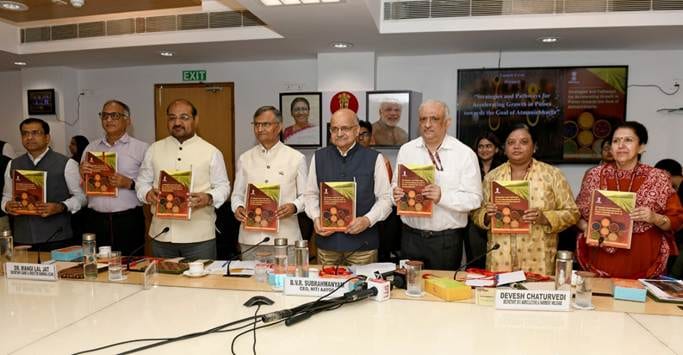
One year into India's six-year Mission for Aatmanirbharta in Pulses, no research project has been approved under its ₹500 crore research component. The Cabinet Secretariat raised the delay at a 5 October 2026 review chaired by Cabinet Secretary T V Somanathan. It asked the Agriculture Ministry to clear projects by 15 November. The research is meant to deliver the better seeds the mission's yield targets depend on.
What is the Mission for Aatmanirbharta in Pulses?
It is a ₹11,440 crore Central mission for 2025-26 to 2030-31, launched on 11 October 2025, to make India self-reliant in pulses. It aims to raise output to 350 lakh tonnes from 310 lakh hectares by 2030-31. Its main levers are better seeds, cluster-based farming in 489 districts, 1,000 processing units and assured procurement of tur, urad and masoor.
expediting the process, and eligible projects recommended by the Committee are expected to be sanctioned by the end of October 2026, ahead of the November 15 timeline
Ministry of Agriculture and Farmers' Welfare, statement to The Indian Express (18 October 2026)
What Happened?
The Indian Express reported on 19 October that the mission's first year ended without a single research project approved. The ministry said it invited proposals after fixing priority research areas. It received 419, including 125 from ICAR institutes and 249 from state agricultural universities. A screening committee shortlisted projects, and researchers are now presenting them to a national R&D committee.
The research money is meant for climate-resilient seed varieties, higher protein and yield, and better post-harvest storage. The Union Cabinet approved the mission on 1 October 2025. Prime Minister Narendra Modi launched it on 11 October 2025.
Why It Matters
The mission's targets rest on yield, not just area. National yield must climb from 957 kg per hectare to 1,130 kg by 2030-31. New varieties take years to breed, test and multiply into certified seed. A lost first year therefore pushes back gains that the final years were counting on. Procurement and higher MSPs can lift output quickly, but only research can lift it cheaply.
The other levers are moving. Per PIB, output rose from 256.83 lakh tonnes in 2024-25 to 274.09 lakh tonnes in 2025-26 (third advance estimates). The import bill fell 31.52%, from ₹46,427.60 crore to ₹31,793.59 crore. Pulses procured rose from about 18.4 lakh tonnes to 31.4 lakh tonnes.
Concept Behind the News: Why India Struggles With Pulses
India is the world's largest producer and consumer of pulses, yet output has long trailed demand. Pulses are grown mostly on rainfed land with low inputs, so yields swing with the monsoon. Farmers have preferred rice and wheat, which have assured procurement at MSP. Pulses are legumes: root nodules host Rhizobium bacteria that fix nitrogen, so they also restore soil fertility.
The mission tackles this on four fronts: seeds, area, prices and processing. It plans 87.5 lakh free seed kits and 126 lakh quintals of certified seed over six years, with a push into rice-fallow land. NAFED and NCCF may buy 100% of tur, urad and masoor offered by registered farmers for four years, from 2025-26 to 2028-29.
Syllabus Connection
- GS-III (Agriculture): Major crops and cropping patterns, MSP, procurement and food security
- GS-III (Agriculture): Technology missions, seeds and agricultural research
- GS-II (Governance): Design and monitoring of government schemes
- GS-I (Geography): Distribution of key crops across India
PYQ Connection
UPSC Prelims 2020
Question: With reference to the production of pulses in India, consider the following statements: 1. Black gram (urad) can be cultivated both as Kharif and Rabi crop. 2. Green-gram (moong) alone accounts for nearly half of pulse production. 3. In the last three decades, while the production of Kharif pulses has increased, the production of Rabi pulses has decreased. Which of the statements given above is/are correct?
- 1 only
- 2 and 3 only
- 2 only
- 1, 2 and 3
Answer: 1 only
Option (a) is correct. Urad is grown in both seasons. Gram (chana), not moong, is the largest pulse, so statement 2 is wrong. Rabi pulse output, led by gram, has risen over three decades, so statement 3 is wrong. Urad is one of the three pulses the mission buys at MSP.
UPSC Prelims 2012
Question: Consider the following crops of India: 1. Cowpea 2. Green gram 3. Pigeon pea Which of the above is/are used as pulse, fodder and green manure?
- 1 and 2 only
- 2 only
- 1 and 3 only
- 1, 2 and 3
Answer: 1 and 2 only
Option (a) is correct, as per the official key. Cowpea and green gram (moong) serve as pulse, fodder and green manure. Pigeon pea (tur) is a long-duration crop grown mainly for grain. Tur is the mission's lead pulse.
UPSC Prelims 2010
Question: In India, during the last decade the total cultivated land for which one of the following crops has remained more or less stagnant?
- Rice
- Oilseeds
- Pulses
- Sugarcane
Answer: Pulses
Option (c) is correct. Area under pulses barely moved in the 2000s because farmers preferred rice and wheat with assured MSP buying. The mission now aims to add 35 lakh hectares, taking pulse area to 310 lakh hectares by 2030-31.
UPSC Prelims 2019
Question: Among the following agricultural commodities imported by India, which one has been the highest in terms of value in the last five years?
- Spices
- Fresh fruits
- Pulses
- Vegetable oils
Answer: Vegetable oils
Option (d) is correct. Vegetable oils are India's largest farm import by value. Pulses are a large import too: their import bill fell 31.52% in 2025-26, from ₹46,427.60 crore to ₹31,793.59 crore.
UPSC Prelims 2002
Question: With reference to Indian agriculture, which one of the following statements is correct?
- About 90 per cent of the area under pulses in India is rainfed.
- The share of pulses in the gross cropped area at the national level has double in the last two decades
- India accounts for about 15 per cent of the total area under rice in the world
- Rice occupies about 34 per cent of the gross cropped area of India
Answer: About 90 per cent of the area under pulses in India is rainfed.
Option (a) is correct. Pulses are grown mostly on rainfed land, which is why yields swing with the monsoon. The share of pulses in gross cropped area did not double, so (b) is wrong. Rainfed cultivation is why the mission stresses climate-resilient seeds.
UPSC Prelims 2007
Question: Which one of the following is the correct sequence in the decreasing order of production (in million tonnes) of the given food grains in India?
- Wheat-Rice-Pulses-Coarse Cereals
- Rice-Wheat-Pulses-Coarse Cereals
- Wheat-Rice-Coarse Cereals-Pulses
- Rice-Wheat-Coarse Cereals-Pulses
Answer: Rice-Wheat-Coarse Cereals-Pulses
Option (d) is correct. India produces more rice than wheat, and coarse cereals (jowar, bajra, maize) outweigh pulses. Pulses remain the smallest foodgrain group, which is why a separate mission targets them.
UPSC Prelims 2022
Question: Which of the following are nitrogen-fixing plants? 1. Alfalfa 2. Amaranth 3. Chickpea 4. Clover 5. Purslane (Kulfa) 6. Spinach Select the correct answer using the code given below:
- 1, 3 and 4 only
- 1, 3, 5 and 6 only
- 2, 4, 5 and 6 only
- 1, 2, 4, 5 and 6
Answer: 1, 3 and 4 only
Option (a) is correct. Alfalfa, chickpea and clover are legumes whose root nodules host nitrogen-fixing Rhizobium bacteria. Amaranth, purslane and spinach are not legumes. Chickpea (gram) is India's largest pulse.
UPSC Prelims 2024
Question: Consider the following plants: 1. Groundnut 2. Horse-gram 3. Soybean How many of the above belong to the pea family?
- Only one
- Only two
- All three
- None
Answer: All three
Option (c) is correct. Groundnut, horse gram and soybean all belong to the pea family (Fabaceae), the legume family that includes every pulse. Like pulses, they fix nitrogen through root nodules.
UPPSC Prelims 2019
Question: Nitrogen fixing bacteria make combination with cells of the roots of
- Pulses
- Rice
- Wheat
- Sugarcane
Answer: Pulses
Option (a) is correct. Rhizobium bacteria form root nodules with leguminous crops such as gram, arhar and moong and fix atmospheric nitrogen. This is why pulses improve soil fertility for the next crop.
UPPSC Prelims 2019
Question: Which of the following is associated with biological nitrogen fixation?
- Red algae
- Brown algae
- Green algae
- Blue-green algae
Answer: Blue-green algae
Option (d) is correct. Blue-green algae (cyanobacteria) are prokaryotes that fix atmospheric nitrogen, as do the Rhizobium bacteria in pulse root nodules. Red, brown and green algae cannot fix nitrogen.
UPSC Prelims 2020
Question: In the context of India, which of the following is/are considered to be practice(s) of eco-friendly agriculture? 1. Crop diversification 2. Legume intensification 3. Tensiometer use 4. Vertical farming Select the correct answer using the code given below:
- 1, 2 and 3 only
- 3 only
- 4 only
- 1, 2, 3 and 4
Answer: 1, 2 and 3 only
Option (a) is correct, as per the official key. Crop diversification, legume intensification and tensiometer-based irrigation are eco-friendly practices. Adding pulses to cereal rotations, as the mission plans for rice-fallow land, is legume intensification.
UPSC Prelims 2021
Question: Among the following, which one is the least water-efficient crop?
- Sugarcane
- Sunflower
- Pearl millet
- Red gram
Answer: Sugarcane
Option (a) is correct. Sugarcane needs far more water per tonne than the other crops listed. Red gram (tur) is among the most water-efficient, one reason pulses suit rainfed and dry areas.
UPSC Prelims 2020
Question: Consider the following statements: 1. In the case of all cereals, pulses and oil-seeds, the procurement at Minimum Support Price (MSP) is unlimited in any State/UT of India. 2. In the case of cereals and pulses, the MSP is fixed in any State/UT at a level to which the market price will never rise. Which of the statements given above is/are correct?
- 1 only
- 2 only
- Both 1 and 2
- Neither 1 nor 2
Answer: Neither 1 nor 2
Option (d) is correct. MSP procurement is not unlimited: pulses and oilseeds are bought within set limits, and cereal buying varies by State. MSP is a floor price, so market prices often rise above it. The mission's 100% procurement promise for tur, urad and masoor changes this for four years.
UPSC Prelims 2010
Question: An objective of the National Food Security Mission is to increase the production of certain crops through area expansion and productivity enhancement in a sustainable manner in the identified districts of the country. What are those crops?
- Rice and wheat only
- Rice, wheat and pulses only
- Rice, wheat, pulses and oilseeds only
- Rice, wheat, pulses, oilseeds and vegetables
Answer: Rice, wheat and pulses only
Option (b) is correct. The National Food Security Mission, launched in 2007, covered rice, wheat and pulses in identified districts. Coarse cereals were added later. The pulses mission reuses its district-cluster model for one crop group.
UPSC Prelims 2009
Question: Consider the following statements: 1. The Commission for Agricultural Costs and Prices recommends the Minimum Support Prices for 32 crops. 2. The Union Ministry of Consumer Affairs, Food and Public Distribution has launched the National Food Security Mission. Which of the statements given above is/are correct?
- 1 only
- 2 only
- Both 1 and 2
- Neither 1 nor 2
Answer: Neither 1 nor 2
Option (d) is correct. In 2009 the CACP recommended MSPs for fewer than 32 crops, and the NFSM was launched by the Agriculture Ministry, not the Food Ministry. Today MSP covers 22 mandated crops, including tur, urad and masoor.
UPSC Prelims 2004
Question: Consider the following statements: 1. Regarding the procurement of food grains, Government of India follows a procurement target rather than an open-ended procurement policy. 2. Government of India announces minimum support prices only for cereals. 3. For distribution under Targeted Public Distribution System (TPDS), wheat and rice are issued by the Government of India at uniform central issue prices to the States/Union Territories. Which of these statements given above is/are correct?
- 1 and 2
- 2 only
- 1 and 3
- 3 only
Answer: 3 only
Option (d) is correct. Wheat and rice procurement is open-ended, so statement 1 is wrong. MSPs are also announced for pulses and oilseeds, so statement 2 is wrong. Wheat and rice are issued to States at uniform central issue prices.
UPSC Prelims 2019
Question: The economic cost of food grains to the Food Corporation of India is Minimum Support Price and bonus (if any) paid to the farmers plus
- transportation cost only
- interest cost only
- procurement incidentals and distribution cost
- procurement incidentals and charges for godowns
Answer: procurement incidentals and distribution cost
Option (c) is correct. FCI's economic cost is MSP plus bonus, procurement incidentals and distribution cost. Pulses bought for the mission are procured by NAFED and NCCF, not FCI.
UPSC Prelims 2001
Question: The prices at which the Government purchases food grains for maintaining the public distribution system and for building up buffer stocks is known as
- minimum support prices
- procurement prices
- issue prices
- ceiling prices
Answer: procurement prices
Option (b) is correct. Procurement prices were the rates at which government bought grain for the PDS and buffer stocks. In practice, MSP now serves as the procurement price, including for pulses bought under the mission.
UPSC Prelims 2023
Question: Consider the following statements: 1. The Government of India provides Minimum Support Price for niger (Guizotia abyssinica) seeds. 2. Niger is cultivated as a Kharif crop. 3. Some tribal people in India use niger seed oil for cooking. How many of the above statements are correct?
- Only one
- Only two
- All three
- None
Answer: All three
Option (c) is correct. Niger is a kharif oilseed covered by MSP, and some tribal communities cook with its oil. It shows that MSP reaches crops beyond rice and wheat, as it does for pulses.
CAPF 2021
Question: The price declared by the Government every year before the sowing season to provide incentives to the farmers is called
- buffer price
- issue price
- minimum support price
- fair sustenance price
Answer: minimum support price
Option (c) is correct. MSP is announced before sowing so farmers know the floor price in advance. For 2026-27, tur MSP is ₹8,450, urad ₹8,200 and masoor ₹7,000 per quintal.
UPSC Prelims 2014
Question: In the context of food and nutritional security of India, enhancing the ‘Seed Replacement Rates’ of various crops helps in achieving the food production targets of the future. But what is/are the constraint/constraints in its wider/greater implementation? 1. There is no National Seeds Policy in place. 2. There is no participation of private-sector seed companies in the supply of quality seeds of vegetables and planting materials of horticultural crops. 3. There is a demand-supply gap regarding quality seeds in case of low-value and high-volume crops. Select the correct answer using the code given below.
- 1 and 2
- 3 only
- 2 and 3
- None
Answer: 3 only
Option (b) is correct, as per the official key. India has had a National Seeds Policy since 2002, and private firms do supply vegetable seeds. The real constraint is a shortage of quality seed for high-volume crops like pulses, which the mission's seed kits target.
UPSC Prelims 2015
Question: Which one of the following best describes the main objective of 'Seed Village Concept'?
- Encouraging the farmers to use their own farm seeds and discouraging them to buy the seeds from others
- Involving the farmers for training in quality seed production and thereby to make available quality seeds to others at appropriate time and affordable cost
- Earmarking some villages exclusively for the production of certified seeds
- Identifying the entrepreneurs in villages and providing them technology and finance to set up seed companies
Answer: Involving the farmers for training in quality seed production and thereby to make available quality seeds to others at appropriate time and affordable cost
Option (b) is correct. The Seed Village concept trains farmers to produce quality seed locally and supply it to others on time and at fair cost. The pulses mission relies on the same idea to spread certified seed.
CDS 2023
Question: Consider the following statements about the Public Distribution System: 1. The Public Distribution System is operated under the joint responsibility of Centre and State/Union Territories. 2. Food Corporation of India has assumed the responsibility for procurement, storage and transportation of food grains to the State Governments. 3. Both Centre and State have the joint responsibility to identify eligible beneficiaries. 4. Some States also distribute additional items of mass consumption through the PDS outlets such as pulses, edible oil, etc. Which of the statements given above are correct?
- 2 and 3 only
- 1, 2 and 4
- 1 and 2 only
- 3 and 4 only
Answer: 1, 2 and 4
Option (b) is correct. The PDS is run jointly, FCI handles central procurement and storage, and some States add pulses and edible oil. Identifying beneficiaries is a State task, so statement 3 is wrong.
CDS 2021
Question: Identify the crop on the basis of the following characteristics: 1. It is a kharif crop. 2. Aus, Aman and Boro are its three different growing periods in an agricultural year. 3. About one-fourth of the total cropped area of India is under its cultivation. Select the correct answer using the code given below.
- Wheat
- Rice
- Pulses
- Cotton
Answer: Rice
Option (b) is correct. Aus, Aman and Boro are rice seasons, and rice covers about a quarter of cropped area. Pulses are the wrong option here, but the mission targets rice-fallow land left after the kharif rice harvest.
Visual Explanation: Output Against the Target
India's pulses production (lakh tonnes)
| 2023-24 | 242 |
|---|---|
| 2024-25 | 256.83 |
| 2025-26 (3rd AE) | 274.09 |
Mission targets vs status after year one
| Indicator | Status (2025-26) | Target (2030-31) |
|---|---|---|
| Production | 274.09 lakh tonnes | 350 lakh tonnes |
| Area | 286.46 lakh ha | 310 lakh ha |
| Yield | 957 kg/ha | 1,130 kg/ha |
| Processing units | 528 allocated to States | 1,000 |
| Research (₹500 crore) | No project approved | Seeds, protein, storage |
Connect the Dots
- 2007: National Food Security Mission covers rice, wheat and pulses in identified districts.
- 2016: UN marks the International Year of Pulses.
- 1 October 2025: Union Cabinet approves the ₹11,440 crore pulses mission.
- 11 October 2025: PM launches the mission; NAFED and NCCF to buy all tur, urad and masoor offered.
- 2025-26: Output reaches 274.09 lakh tonnes; imports fall 31.52% by value.
- 5 October 2026: Cabinet Secretariat flags that no research project is approved.
- 15 November 2026: Deadline to approve research projects.
Read More
Read More
- PIB Factsheet: India's Mission for Aatmanirbharta in Pulses (Official targets, MSPs, procurement and first-year progress)
- Rabi MSP Hike: Safflower Gains 10.3%, Wheat Only 1% (Previous DORI article on how MSP steers crop choices)
Exam Takeaway
- Mission for Aatmanirbharta in Pulses: ₹11,440 crore, 2025-26 to 2030-31, launched on 11 October 2025.
- Targets by 2030-31: 350 lakh tonnes output, 310 lakh hectares, 1,130 kg per hectare yield.
- Focus pulses are tur, urad and masoor; NAFED and NCCF buy 100% offered for four years.
- ₹500 crore is set aside for research; no project was approved in year one.
- 2025-26 output (third advance estimates): 274.09 lakh tonnes; imports down 31.52% by value.
Exam Angle
Prelims can test the mission's outlay, target crops, procuring agencies and the legume nitrogen link. Mains can ask: "Can assured procurement alone make India self-reliant in pulses?" Argue that prices lift area quickly, but yield needs seeds and research. Cite the stalled ₹500 crore fund and the 957 to 1,130 kg yield gap.
Possible Question
Practice Question
Question: With reference to the Mission for Aatmanirbharta in Pulses, consider the following statements: 1. It runs from 2025-26 to 2030-31 with an outlay of ₹11,440 crore. 2. It provides for procurement of tur, urad and masoor through NAFED and NCCF. 3. It targets pulses production of 350 lakh tonnes by 2030-31. Which of the statements given above is/are correct?
- 1 only
- 1 and 2 only
- 2 and 3 only
- 1, 2 and 3
Answer: 1, 2 and 3
All three statements are correct. The mission runs for six years from 2025-26 with ₹11,440 crore. NAFED and NCCF are authorised to buy 100% of tur, urad and masoor offered by registered farmers for four years. Its production target for 2030-31 is about 350 lakh tonnes.
Sources & Further Reading
- The Indian Express: Modi's Rs 11,440-crore mission: No research project approved in Year 1 (19 October 2026)
- Financial Express: Self-reliance in pulses at risk? Rs 500 crore research fund sees no approvals in first year (19 October 2026)
- PIB Factsheet: India's Mission for Aatmanirbharta in Pulses (11 October 2026)
- PIB Backgrounder: India's Mission for Aatmanirbharta in Pulses: Enhancing Production and Farmers' Income (11 October 2025)