
Bharatiya Vayuyan Niyam 2026: A New Aviation Rulebook
A PIB factsheet of 4 November 2026 says the Bharatiya Vayuyan Niyam, 2026 replaces the Aircraft Rules, 1937, with 220 rules, graded penalties up to ₹1 crore and clearer fare disclosure, from 1 January 2027.
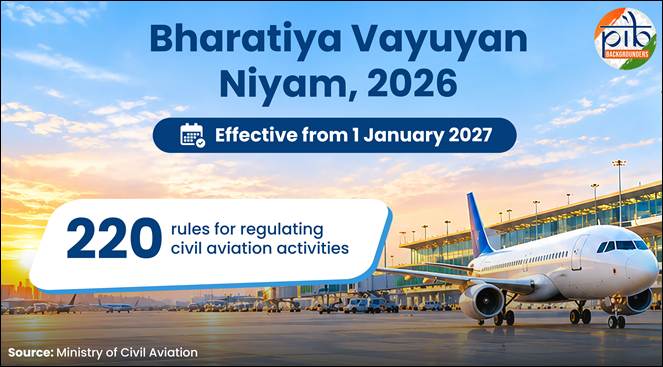
The Ministry of Civil Aviation has notified the Bharatiya Vayuyan Niyam, 2026, a 220-rule code that replaces the Aircraft Rules, 1937. It is made under the Bharatiya Vayuyan Adhiniyam, 2024 and takes effect on 1 January 2027. A PIB factsheet of 4 November 2026 says growth, new aircraft technology and aircraft financing needed a modern, safety-focused rulebook for DGCA to enforce.
What is the Bharatiya Vayuyan Niyam, 2026?
It is India’s new civil aviation rulebook, made under the Bharatiya Vayuyan Adhiniyam, 2024. It has 220 rules in eight chapters and six schedules. It replaces the Aircraft Rules, 1937 and Part IX of the Aircraft Rules, 1920, and comes into force on 1 January 2027.
The Rules seek to strike a balance between the commercial flexibility of airlines, ease of doing business and the protection of passenger interests.
PIB factsheet, Ministry of Civil Aviation (4 November 2026)
What Happened?
The Government notified the Bharatiya Vayuyan Niyam, 2026 to give effect to the Bharatiya Vayuyan Adhiniyam, 2024. The Niyam replaces the Aircraft Rules, 1937, which served as the principal rulebook for decades. It also replaces Part IX of the Aircraft Rules, 1920 and repeals the Radio Telephone Operator (Restricted) Certificate and Licence Rules, 2025, subject to savings provisions.
The code covers aircraft registration, airworthiness, personnel licensing, aerodrome operations, air navigation services and aircraft operations. It also lays down oversight, safety management, enforcement and penalties. Operational airports rose from 74 in 2014 to 166 as of October 2026, which PIB gives as the reason for modernising the rules.
DGCA may issue type certificates for aircraft, engines and propellers where India is the State of Design. It may also accept foreign type certificates on conditions. The Rules add fractional ownership, where an aircraft is jointly owned but one party is clearly responsible for operation and maintenance.
The Rules work with the Protection of Interests in Aircraft Objects Act, 2025, which applies the Cape Town Convention framework to aircraft leasing. Its IDERA mechanism (Irrevocable De-registration and Export Request Authorisation) gives a time-bound path to deregister and export eligible aircraft. Eligible IDERA applications for cancellation must be processed within five working days.
Airlines must set tariffs based on operating costs and publish them digitally. Booking websites and tickets must show the total payable amount with a fare, tax and fee breakdown. In extraordinary situations the Central Government may issue proportionate, time-bound directions in the public interest.
Why It Matters
A rulebook from 1937 could not handle fractional ownership, leasing finance or Indian-designed aircraft. Clear deregistration timelines may lower leasing risk, and PIB says this may over time ease costs and airfares. Graded penalties replace blunt punishment, which suits a sector where most lapses are procedural. Fare transparency shifts some power to the passenger.
PIB says the rules may help ease airfares, but gives no estimate of the saving. The factsheet also does not say how DGCA will be staffed for more inspections and safety reporting. Both points need watching after 1 January 2027.
Concept Behind the News: Who Regulates the Sky?
Civil aviation law has three layers. The Chicago Convention and its Annexes set global standards, and the Niyam lets DGCA prescribe standards consistent with them. The Bharatiya Vayuyan Adhiniyam, 2024 is the parent Act. The Niyam is delegated legislation that fills in detail on licensing, safety and operations.
DGCA is the regulator. It issues certificates and licences and runs a State Safety Programme. It uses NOTAMs, Aeronautical Information Publications and Civil Aviation Requirements (CARs) to give directions. Draft CARs are ordinarily published for 30 days to invite objections, which can be shortened in the public interest.
Syllabus Connection
- GS-II (Governance): rules, regulators and delegated legislation
- GS-III (Infrastructure): airports, civil aviation and investment models
- Prelims (Current Affairs and Economy): new laws, DGCA, airports and PPP in aviation
- CAPF (General Studies): Indian economy, public sector undertakings and infrastructure
- UPPSC PCS Prelims (General Studies): current affairs, infrastructure and Uttar Pradesh airports
PYQ Connection
UPSC Prelims 2024
Question: Consider the following airports: 1. Donyi Polo Airport 2. Kushinagar International Airport 3. Vijayawada International Airport In the recent past, which of the above have been constructed as Greenfield projects?
- 1 and 2 only
- 2 and 3 only
- 1 and 3 only
- 1, 2 and 3
Answer: 1 and 2 only
Option (a) is correct. Donyi Polo Airport (Arunachal Pradesh) and Kushinagar International Airport (Uttar Pradesh) were built as greenfield projects, on fresh land with no earlier airport. Vijayawada was an existing airport that was expanded, so statement 3 is wrong. Airport growth from 74 to 166 operational airports, cited in the PIB factsheet, includes such new builds.
UPPSC Prelims 2020
Question: Which of the following Airports in Uttar Pradesh has been granted International Status on 24th June, 2020 by Union Cabinet of India ?
- Agra Airport
- Prayagraj Airport
- Gorakhpur Airport
- Kushinagar Airport
Answer: Kushinagar Airport
Option with Kushinagar Airport is correct. The Union Cabinet approved international status for Kushinagar Airport on 24 June 2020. It links Buddhist pilgrimage circuits to foreign flights. The new Niyam sets licensing rules for such public-use aerodromes.
UPPSC Prelims 2022
Question: The first airport powered by solar energy in India is
- Cochin
- New Delhi
- Chennai
- Ahmedabad
Answer: Cochin
Cochin is correct. Cochin International Airport became the first in India, and the world, to run fully on solar power. The Niyam covers aerodrome safety and operations, which sit alongside such energy choices.
CAPF 2020
Question: Which one of the following Central Public Sector Undertakings (CPSUs) is recognized as Miniratnas?
- Airport Authority of India
- Indian Oil Corporation Limited
- Hindustan Aeronautics Limited
- Steel Authority of India Limited
Answer: Airport Authority of India
Airport Authority of India is correct. AAI is a Miniratna CPSU that manages most civil airports. The Niyam gives DGCA, not AAI, the licensing and safety oversight role, so AAI is the operator and DGCA the regulator.
Visual Explanation: Airports and Penalties
Operational airports in India
| 2014 | 74 |
|---|---|
| October 2026 | 166 |
Bharatiya Vayuyan Niyam, 2026 at a glance
| Area | What the Rules provide |
|---|---|
| Structure | 220 rules, eight chapters, six schedules |
| Penalties | 21 punishable offences (up to 2 years, up to ₹1 crore, or both) and 18 compoundable offences |
| Graded penalties | Ten severity levels, from ₹10,000 to ₹1 crore |
| Cabin crew | One member for 10 to 50 seat aeroplanes, two above 50 seats, plus one per 50 seats beyond 99 |
| Licensing | 23 categories of licences, ratings and certificates |
| Alcohol | Banned on domestic air transport services; crew barred for 12 hours before a flight |
Connect the Dots
- Operational airports grow from 74 in 2014 to 166 in October 2026.
- The Bharatiya Vayuyan Adhiniyam, 2024 gives the legislative basis for modernisation.
- The Niyam, 2026 replaces the Aircraft Rules, 1937 from 1 January 2027.
- DGCA gains clear powers on type certification, safety reporting and graded penalties.
- The 2025 Act and IDERA speed up aircraft deregistration and export for lessors.
- Fare disclosure and passenger safeguards tie the rulebook to ease of travel.
Read More
Read More
- PIB factsheet: Bharatiya Vayuyan Niyam, 2026 (Official source for every figure in this article)
- Container Manufacturing Promotion Scheme: ₹10,000 Cr Push (Earlier DORI article on logistics and transport capacity)
Exam Takeaway
- Niyam 2026: 220 rules, eight chapters, six schedules; in force from 1 January 2027.
- Replaces the Aircraft Rules, 1937 and Part IX of the Aircraft Rules, 1920; parent Act is the Bharatiya Vayuyan Adhiniyam, 2024.
- Penalties: 21 punishable offences, 18 compoundable, ten severity levels from ₹10,000 to ₹1 crore.
- IDERA under the Protection of Interests in Aircraft Objects Act, 2025 (Cape Town framework); five working days for eligible cancellations.
- Airports: 74 (2014) to 166 (October 2026); nationality mark VT.
Exam Angle
Prelims can ask what replaced the Aircraft Rules, 1937, the role of DGCA, or what IDERA does. Mains can ask whether decriminalisation and graded penalties improve safety. Argue that predictable rules attract lessors and investors, but safety depends on DGCA capacity and honest reporting.
Possible Question
Practice Question
Question: With reference to the Bharatiya Vayuyan Niyam, 2026, consider the following statements: 1. It replaces the Aircraft Rules, 1937. 2. It is made under the Bharatiya Vayuyan Adhiniyam, 2024. 3. It prescribes a single flat penalty of ₹10,000 for all contraventions. Which of the statements given above is/are correct?
- 1 and 2 only
- 2 and 3 only
- 1 and 3 only
- 1, 2 and 3
Answer: 1 and 2 only
Statements 1 and 2 are correct. Statement 3 is wrong: the Rules set a graded penalty structure of ten severity levels, with monetary penalties from ₹10,000 to ₹1 crore depending on the contravention and the offender.