
Social Security Coverage 68.4%: What EPFO Reforms Add
A PIB Backgrounder of 31 October 2026 says social protection coverage rose from 19% in 2015 to 68.4% in 2026, and lists EPFO's wage ceiling rise to ₹25,000, simpler PF withdrawals and digital reforms.
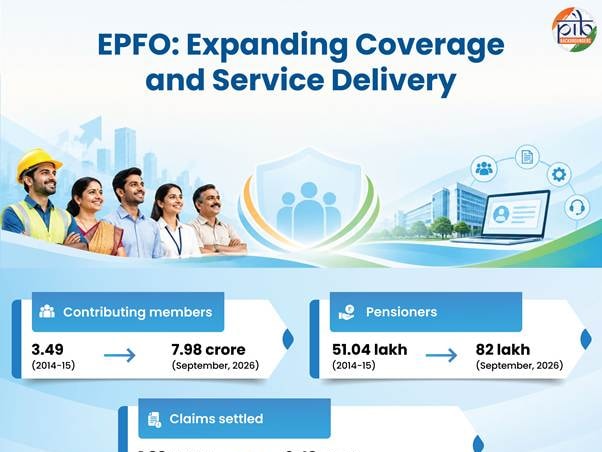
The Labour Ministry's PIB Backgrounder of 31 October 2026 says India's social protection coverage rose from 19% in 2015 to 68.4% in 2026. EPFO contributing members grew from 3.49 crore in 2014-15 to about 7.98 crore by 16 September 2026. A September 2026 decision lifts the mandatory wage ceiling from ₹15,000 to ₹25,000 a month, adding over 51 lakh employees.
What changes has India made to EPFO coverage and withdrawals in 2026?
In September 2026 the mandatory EPFO wage ceiling rose from ₹15,000 to ₹25,000 a month, which PIB says brings over 51 lakh more employees into coverage. Partial withdrawal rules were cut from 13 provisions to three categories. Members can withdraw up to 75% of their PF balance, and auto-settlement of advance claims was raised to ₹5 lakh.
Social protection coverage increased from 19% in 2015 to 68.4% in 2026.
PIB Backgrounder, Ministry of Labour and Employment (31 October 2026)
What Happened?
The Ministry of Labour and Employment's backgrounder says the social security framework has widened through EPFO coverage, digital reforms and welfare initiatives. EPFO is a statutory body under the Ministry and administers provident fund, pension and insurance schemes. PIB calls it one of the world's largest social security institutions.
Three schemes now sit under the Code on Social Security, 2020. The new EPF Scheme 2026 replaced the older provident fund scheme. EPS 2026 replaced the Employees' Pension Scheme, 1995. EDLI 2026 replaced the 1976 insurance scheme and gives cover of up to ₹7 lakh with no separate premium.
The wage ceiling was last revised in September 2014, from ₹6,500 to ₹15,000 a month. In September 2026 a rise to ₹25,000 was approved. PIB expects over 51 lakh additional employees to fall under mandatory coverage.
EPFO has merged 13 partial-withdrawal provisions into three categories: Essential Needs, Housing Needs and Special Circumstances. Members may now make up to 10 withdrawals for education and 5 for marriage, against a combined limit of 3 earlier. The framework introduced in October 2025 allows withdrawal of up to 75% of the PF balance, with 12 months of service required.
The auto-settlement limit for eligible advance claims is now ₹5 lakh. Cheque-leaf images and attested passbooks are no longer needed for eligible online claims. In the last year to October 2026, EPFO settled 6.42 crore claims, against 1.30 crore in 2014-15.
Two compliance schemes also feature. VISHWAS, 2026 allows one-time settlement of disputes over damages or penalties, with reduced monthly damage rates of 0.25%, 0.50% or 1% for pre-14 June 2024 defaults. AMNESTY, 2026 lets eligible provident fund trusts regularise exemption retrospectively and is open until 28 December 2026.
Why It Matters
A higher ceiling brings more mid-wage workers into mandatory saving, pension and insurance. Contributions come out of wages, so take-home pay in the new band may dip while retirement savings rise. Employers also face a larger payroll cost. Easier withdrawals help in emergencies but can also drain long-term retirement savings.
The backgrounder does not explain how the 68.4% figure is measured or how many gig and platform workers it includes. It names e-Shram, PM-SYM and the Pradhan Mantri Samajik Sahayata Yojana for unorganised and vulnerable groups, but gives no enrolment numbers for them.
Concept Behind the News: Three Pillars of EPFO Security
EPFO's architecture rests on three pillars: provident fund savings, pension benefits and insurance protection. The EPF builds retirement savings from contributions and interest and permits partial withdrawals for housing, higher education, marriage and medical treatment. The EPS pays monthly pension on retirement, superannuation or disability, and to eligible dependants.
The Universal Account Number (UAN) is a permanent number that links a member's PF accounts across employers and lets balances move when jobs change. Workers can self-generate a UAN. By October 2026, 1.74 crore self-generated UANs were reported. Face authentication through the UMANG app began in April 2025.
Syllabus Connection
- GS-III (Economy): inclusive growth, employment and labour reforms
- GS-II (Governance): welfare schemes for vulnerable sections and statutory bodies
- Prelims (Economy): social security schemes, EPFO, PM-SYM and the four labour codes
- CDS (General Knowledge): Indian economy and current events
- UPPSC PCS Prelims (General Studies): Indian economy, labour and social security schemes
PYQ Connection
UPSC Prelims 2024
Question: With reference to the Pradhan Mantri Shram Yogi Maan - dhan (PM - SYM) Yojana, consider the following statements : 1. The entry age group for enrolment in the scheme is 21 to 40 years. 2. Age specific contribution shall be made by the beneficiary. 3. Each subscriber under the scheme shall receive a minimum pension of ₹ 3,000 per month after attaining the age of 60 years. 4. Family pension is applicable to the spouse and unmarried daughters. Which of the statements given above is/are correct?
- 1, 3 and 4
- 2 and 3 only
- 2 only
- 1, 2 and 4
Answer: 2 and 3 only
Option (b) is correct. Statements 2 and 3 are right: the contribution depends on the age of entry, and the assured pension is ₹3,000 a month after 60. Statement 1 is wrong because entry age is 18 to 40. Statement 4 is wrong because family pension goes to the spouse only. PM-SYM is one of the schemes for unorganised workers named in the PIB backgrounder.
CDS 2021
Question: Which of the following is/are social security scheme(s)? 1. Atal Pension Yojana 2. Pradhan Mantri Jeevan Jyoti Bima Yojana 3. Pradhan Mantri Suraksha Bima Yojana Select the correct answer using the code given below:
- 1 only
- 2 and 3 only
- 1, 2 and 3
- 1 and 3 only
Answer: 1, 2 and 3
Option (c) is correct. Atal Pension Yojana gives a pension, Jeevan Jyoti Bima Yojana gives life cover and Suraksha Bima Yojana gives accident cover. All three are government social security schemes, alongside EPFO's own PF, pension and insurance pillars.
CDS 2022
Question: Which one of the following Labour Codes notified by the Government of India incorporated various provisions of the Central Labour Acts such as the Factories Act, 1948 and Plantations Labour Act, 1951?
- The Occupational Safety, Health and Working Conditions Code, 2020
- The Industrial Relations Code, 2020
- The Code on Wages, 2019
- The Code on Social Security, 2020
Answer: The Occupational Safety, Health and Working Conditions Code, 2020
Option (a) is correct. The Occupational Safety, Health and Working Conditions Code, 2020 subsumed the Factories Act, 1948 and the Plantations Labour Act, 1951, among other laws. The Code on Social Security, 2020, now home to the EPF, EPS and EDLI schemes, covers provident fund, pension and insurance laws instead.
UPPSC Prelims 2024
Question: Match List-I with List-II and choose the correct answer using the codes given below the lists : List-I (Social Security Programme) A. Pradhan Mantri Shram Yogi Maan-Dhan Yojana B. Pradhan Mantri Jeevan Jyoti Bima Yojana C. Pradhan Mantri Suraksha Bima Yojana D. Atal Pension Yojana List-II (Beneficiary's Contribution) 1. Beneficiary's choice 2. ₹ 55 - ₹ 200 per month 3. ₹ 436 per year 4. ₹ 20 per year Codes :
- A-2, B-3, C-4, D-1
- A-2, B-4, C-1, D-3
- A-1, B-2, C-3, D-4
- A-3, B-2, C-1, D-4
Answer: A-2, B-3, C-4, D-1
Option (a) is correct. PM-SYM is a monthly contribution of ₹55 to ₹200 by age of entry. Jeevan Jyoti Bima has a premium of ₹436 a year. Suraksha Bima costs ₹20 a year. In Atal Pension Yojana the contribution depends on the pension the subscriber chooses and the age of entry.
Visual Explanation: The Wage Ceiling and EPFO's Growth
EPFO mandatory coverage wage ceiling (₹ per month)
| Before Sep 2014 | 6500 |
|---|---|
| Sep 2014 | 15000 |
| Sep 2026 | 25000 |
EPFO then and now
| Indicator | 2014-15 | Latest |
|---|---|---|
| Contributing members | 3.49 crore | About 7.98 crore (16 September 2026) |
| Pensioners | 51.04 lakh | About 82 lakh (September 2026) |
| Claims settled | 1.30 crore | 6.42 crore (last year, to October 2026) |
| Contributing establishments | Not stated | 7.68 lakh (September 2026) |
Connect the Dots
- The Code on Social Security, 2020 houses the new EPF, EPS and EDLI schemes of 2026.
- The wage ceiling rises from ₹15,000 to ₹25,000, adding over 51 lakh employees to mandatory coverage.
- Thirteen withdrawal provisions become three categories, with up to 75% of the PF balance accessible.
- Auto-settlement of advance claims reaches ₹5 lakh and bank proof rules are relaxed.
- UAN self-generation, Aadhaar face authentication and the UMANG app move enrolment and claims online.
- CPPS and doorstep life certificates carry pensions to about 82 lakh pensioners.
Read More
Read More
- PIB Backgrounder: India's Social Security Coverage (Official source for every figure in this article)
- Make in India Outpaced Peers in a Harsher Trade Decade (Earlier DORI article on manufacturing and jobs, the formal workforce behind EPFO)
Exam Takeaway
- Social protection coverage: 19% (2015) to 68.4% (2026), per PIB; over one billion people.
- EPFO: 7.98 crore contributing members, 7.68 lakh establishments, about 82 lakh pensioners.
- Wage ceiling: ₹6,500 to ₹15,000 (September 2014), then ₹25,000 (September 2026); over 51 lakh more employees.
- Schemes under the Code on Social Security, 2020: EPF 2026, EPS 2026, EDLI 2026 (cover up to ₹7 lakh).
- Withdrawals: 13 provisions in three categories, up to 75% of balance, auto-settlement to ₹5 lakh.
Exam Angle
Prelims can test EPFO's status, the schemes under the Code on Social Security and PM-SYM details. Mains can ask whether mandatory coverage helps or burdens low-wage workers. Argue that wider coverage builds security, but informal and gig workers need schemes that do not depend on an employer.
Possible Question
Practice Question
Question: With reference to the Employees' Provident Fund Organisation (EPFO), consider the following statements: 1. The mandatory coverage wage ceiling was last revised in September 2014, from ₹6,500 to ₹15,000 a month, before the 2026 rise to ₹25,000. 2. The 2026 wage ceiling revision is expected to bring over 51 lakh additional employees under mandatory coverage. 3. The EDLI 2026 scheme requires members to pay a separate insurance premium for cover of up to ₹7 lakh. Which of the statements given above is/are correct?
- 1 and 2 only
- 2 and 3 only
- 1 and 3 only
- 1, 2 and 3
Answer: 1 and 2 only
Statements 1 and 2 are correct. Statement 3 is wrong: EDLI 2026 gives insurance cover of up to ₹7 lakh without requiring members to pay a separate insurance premium.