Maharashtra Drought: How 304 Talukas Qualify for Relief
Maharashtra has declared drought in 304 of its 358 talukas after an El Nino-hit monsoon, and farmers are questioning the ₹5,000 interim aid while crop-loss surveys continue.
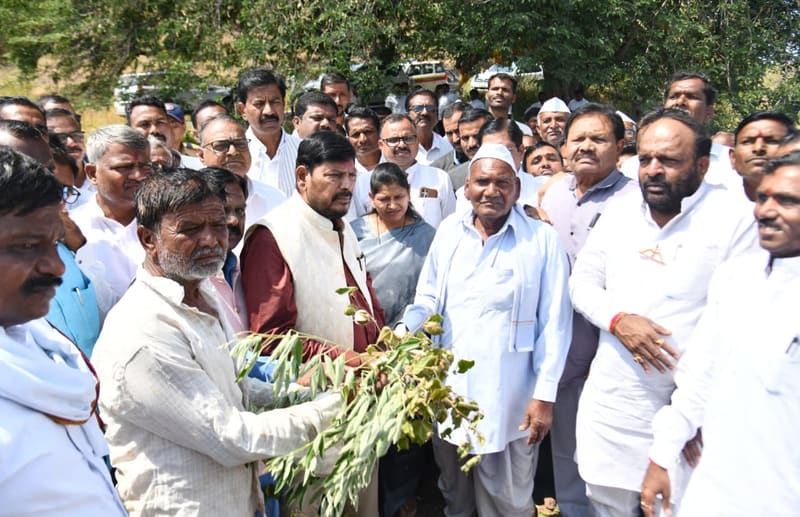
Maharashtra has declared drought in 304 of its 358 talukas after a weak, El Nino-hit monsoon. Chief Minister Devendra Fadnavis announced ₹5,000 interim relief per farmer on 14 October, to be paid before Diwali. Crop-loss compensation will come only after field surveys. Some farmers have called the advance too small; one sent it back by money order.
How is drought declared in Maharashtra?
Maharashtra declares drought under its Drought Management Code, 2016. Trigger-1 rests on rainfall deficit and dry spells of at least 21 days. Trigger-2 adds impact checks, after which talukas are declared drought-hit and field surveys (panchnamas) record crop damage with photos and GPS. Twelve relief measures apply at once; crop-loss aid follows the surveys.
I cultivated a soybean crop on 1.5 acres of my farm. I spent ₹25,000 and received a 60-kg yield. I could earn just ₹3,900.
Chand Shaikh, farmer from Surdi village, Dharashiv, speaking to reporters (PTI, 17 October 2026)
What Happened?
On 26 September, the State declared 265 talukas in 32 districts drought-hit under Trigger-1. Between 1 June and 26 September, Maharashtra received 798.2 mm of rain against an average of 970.9 mm. On 14 October, 39 more talukas were added after Trigger-2, taking the total to 304, per the State's relief department. Some reports put the count at 305.
The 12 measures include land revenue exemption, crop loan restructuring and a stay on farm loan recovery. They also cover electricity bill relief for farm pumps, exam fee waivers and relaxed job-scheme norms. Drinking water tankers and fodder are also provided. Fadnavis said the ₹5,000 advance was paid because full assessments and Central procedures cannot finish before Diwali.
The shortfall is hitting markets too. At Nashik's Pimpalgaon APMC, tomato prices fell nearly 65% in a week, to ₹111 per 20-kg crate. Pune has cut water supply every Thursday until the next monsoon.
Why It Matters
Drought is a slow-onset disaster, so relief often arrives after the harm is done. Surveys, assessments and Central approval take weeks, while farmers face loan dues and festival spending now. A flat ₹5,000 advance buys time but bears little relation to actual losses. The dispute shows why timely, data-based loss assessment matters as much as the size of aid.
Concept Behind the News: Who Pays for Drought Relief?
States declare drought and pay relief first from their State Disaster Response Fund (SDRF), which the Centre co-funds. For a disaster of severe nature, a State can seek extra help from the National Disaster Response Fund (NDRF). An inter-ministerial central team then assesses the damage. The Disaster Management Act, 2005 and the NDMA, chaired by the Prime Minister, frame this system.
MHA's SDRF and NDRF norms for 2022-23 to 2025-26 set crop input subsidy at ₹8,500 per hectare for rainfed land. The rate is ₹17,000 for irrigated land and ₹22,500 for perennial crops. Aid applies where crop loss is 33% or more, up to 2 hectares per farmer.
Those rates were fixed for the Fifteenth Finance Commission period ending March 2026. The reports reviewed do not say which norms will apply to this year's claims. Readers should check the State's final crop-loss resolution.
Syllabus Connection
- GS-III (Disaster Management): Drought, preparedness, relief and the role of SDRF and NDRF
- GS-III (Agriculture): Rainfed farming, crop insurance and farmer distress
- GS-I (Geography): Monsoon, El Nino and drought-prone regions
- GS-II (Governance): Centre-State roles in welfare and relief
PYQ Connection
UPSC Prelims 2014
Question: Consider the following pairs: Programme/Project-Ministry 1. Drought-Prone Area Programme: Ministry of Agriculture 2. Desert Development Programme: Ministry of Environment and Forests 3. National Watershed Development Project for Rainfed Areas: Ministry of Rural Development Which of the above pairs is/are correctly matched?
- 1 and 2 only
- 3 only
- 1, 2 and 3
- None
Answer: None
Option (d) is correct, as per the official key. The Drought-Prone Area Programme and Desert Development Programme were run by the Ministry of Rural Development, and the rainfed-area watershed project by the Agriculture Ministry. So none of the pairs match.
CAPF 2022
Question: Which one of the following statements is not correct?
- The 'Swarna Jayanti Shahari Rozgar Yojana' is an urban self-employment programme.
- Drought-Prone Area Programme and Desert Development Programme were launched in 1970s.
- The 'Sampoorna Grameen Rozgar Yojana' was launched after restructuring the 'Integrated Rural Development Programme' in 2001.
- The 'Swarna Jayanti Gram Swarozgar Yojana' is a rural self-employment programme.
Answer: The 'Sampoorna Grameen Rozgar Yojana' was launched after restructuring the 'Integrated Rural Development Programme' in 2001.
Option (c) is the incorrect statement. SGRY (2001) merged the Employment Assurance Scheme and Jawahar Gram Samriddhi Yojana, not IRDP. DPAP (1973-74) and DDP (1977-78) were indeed launched in the 1970s for drought and desert areas.
CDS 2021
Question: The Government wants to prepare a plan for drought prone areas of the country. Which one of the following regions will be predominantly focused?
- Coastal Andhra Pradesh
- Ganga plains
- North-eastern region
- Kutch region
Answer: Kutch region
Option (d) is correct. Kutch is arid and drought-prone, unlike the wetter coastal Andhra, Ganga plains and North-East. Marathwada and western Vidarbha are Maharashtra's own drought-prone belt.
CDS 2025
Question: Which one among the following is not an atmospheric natural disaster?
- Drought
- Hailstorm
- Frost
- Avalanche
Answer: Avalanche
Option (d) is correct. Drought, hailstorm and frost are atmospheric (weather-related) hazards; an avalanche is a snow and slope hazard. Drought is also a slow-onset disaster.
CDS 2020
Question: The National Disaster Management Authority functions under the Ministry of
- Environment, Forest and Climate Change
- Home Affairs
- Commerce and Industry
- Finance
Answer: Home Affairs
Option (b) is correct. NDMA works under the Ministry of Home Affairs, which also frames the SDRF and NDRF norms of assistance.
CDS 2021
Question: National Disaster Management Authority is headed by
- the Prime Minister.
- the Home Minister.
- the President.
- the Health Minister.
Answer: the Prime Minister.
Option (a) is correct. The Prime Minister chairs NDMA under the Disaster Management Act, 2005. Chief Ministers chair the State Disaster Management Authorities.
UPPSC Prelims 2021
Question: The National Disaster Management Division in India is the nodal division in the Ministry of Home Affairs for disaster management. Who is the Ex-officio Chairman of the National Disaster Management Authority?
- The Prime Minister
- The Home Minister
- The Defence Minister
- The Health and Family Welfare Minister
Answer: The Prime Minister
Option (a) is correct. The Prime Minister is the ex-officio chairperson of NDMA, while MHA's Disaster Management Division is the nodal division.
UPPSC Prelims 2020
Question: Which of the following gave legal basis to extra-ordinary powers exercised by the Government of India during Lockdown? 1. Mental Health Care Act, 2017 2. Disaster Management Act, 2005 3. Enemy Property Act, 1968 4. Epidemic Diseases Act, 1897 Select the correct answer from the codes given below. Codes:
- 1, 2 and 3
- 2, 3 and 4
- 2 and 4
- 1, 3 and 4
Answer: 2 and 4
Option (c) is correct. The 2020 lockdown rested on the Disaster Management Act, 2005 and the Epidemic Diseases Act, 1897. The same 2005 Act sets up the SDRF and NDRF that fund drought relief.
CDS 2025
Question: Which of the following statements with reference to National Institute of Disaster Management (NIDM) is/are correct? 1. It was constituted in the year 2006. 2. Under the Disaster Management Act, 2005, the Institute has been entrusted to assist in national level policy formulation with reference to Disaster Management. Select the answer using the code given below:
- 1 only
- 2 only
- Both 1 and 2
- Neither 1 nor 2
Answer: 2 only
Option (b) is correct. NIDM began in 1995 as a national centre and was renamed in 2003, so statement 1 is wrong. Under the Disaster Management Act, 2005, it assists national policy on disaster management.
UPSC Prelims 2002
Question: For short-term climate prediction, which one of the following events, detected in the last decade, is associated with occasional weak monsoon rains in the Indian sub-continent?
- La Niña
- Movement of Jet Streams
- El Niño and Southern Oscillations
- Greenhouse effects on global level
Answer: El Niño and Southern Oscillations
Option (c) is correct. El Nino and the Southern Oscillation (ENSO) are linked to weak Indian monsoons. This year's 18% shortfall in Maharashtra is blamed on El Nino.
UPSC Prelims 2011
Question: La Nina is suspected to have caused recent floods in Australia. How is La Nina different from El Nino? 1. La Nina is characterised by unusually cold ocean temperature in equatorial Indian Ocean whereas El Nino is characterised by unusually warm ocean temperature in the equatorial Pacific Ocean. 2. El Nino has adverse effect on south-west monsoon of India, but La Nina has no effect on monsoon climate. Which of the statements given above is/are correct?
- 1 only
- 2 only
- Both 1 and 2
- Neither 1 nor 2
Answer: Neither 1 nor 2
Option (d) is correct. La Nina is a cooling of the equatorial Pacific, not the Indian Ocean, so statement 1 is wrong. La Nina usually strengthens the Indian monsoon, so statement 2 is wrong too.
UPSC Prelims 2010
Question: A new type of El Nino called El Nino Modoki appeared in the news. In this context, consider the following statements: 1. Normal El Nino forms in the Central Pacific ocean whereas El Nino Modoki forms in Eastern Pacific ocean. 2. Normal El Nino results in diminished hurricanes in the Atlantic ocean but El Nino Modoki results in a greater number of hurricanes with greater frequency. Which of the statements given above is/are correct?
- 1 only
- 2 only
- Both 1 and 2
- Neither 1 nor 2
Answer: 2 only
Option (b) is correct. A normal El Nino warms the eastern Pacific, while El Nino Modoki warms the central Pacific, so statement 1 reverses them. Modoki is linked to more Atlantic hurricanes.
UPSC Prelims 2017
Question: With reference to ‘Indian Ocean Dipole (IOD)’, sometimes mentioned in the news while forecasting Indian monsoon, which of the following statements is/are correct? 1. IOD phenomenon is characterised by a difference in sea surface temperature between tropical Western Indian Ocean and tropical Eastern Pacific Ocean. 2. An IOD phenomenon can influence an El Niño’s impact on the monsoon. Select the correct answer using the code given below:
- 1 only
- 2 only
- Both 1 and 2
- Neither 1 nor 2
Answer: 2 only
Option (b) is correct. The IOD is a temperature difference between the western and eastern tropical Indian Ocean, not the Pacific. A positive IOD can soften an El Nino's drag on the monsoon.
CAPF 2022
Question: Which of the following statements is/are correct? 1. The jet streams are high altitude easterly winds. 2. El Niño is a warm ocean current. 3. El Niño appears along the Peru coast. Select the correct answer using the code given below.
- 1 only
- 2 and 3 only
- 1 and 3 only
- 1, 2 and 3
Answer: 2 and 3 only
Option (b) is correct. El Nino is a warm current that appears off the coast of Peru. Jet streams are mostly high-altitude westerlies, so statement 1 is wrong.
CDS 2022
Question: Which one of the following is not a resultant of the El Nino effect?
- Distortion of equatorial atmospheric circulation
- Flow of the South-East Trade Winds towards the Indian Ocean
- Irregularities in the evaporation of sea water
- Reduction in the amount of planktons which reduces the number of fish in the sea
Answer: Flow of the South-East Trade Winds towards the Indian Ocean
Option (b) is correct. El Nino weakens the south-east trade winds instead of driving them towards the Indian Ocean. It distorts circulation, disturbs evaporation and cuts plankton and fish catch.
UPSC Prelims 2012
Question: Consider the following crops of India: 1. Groundnut 2. Sesamum 3. Pearl millet Which of the above is/are predominantly rainfed crop/crops?
- 1 and 2 only
- 2 and 3 only
- 3 only
- 1, 2 and 3
Answer: 1, 2 and 3
Option (d) is correct. Groundnut, sesamum and pearl millet are mainly rainfed, so a monsoon failure hits them directly. Soybean, Maharashtra's main kharif crop, is also largely rainfed.
CDS 2023
Question: Which one of the following crops is not cultivated under dryland farming?
- Jowar
- Ragi
- Sugarcane
- Groundnut
Answer: Sugarcane
Option (c) is correct. Sugarcane needs heavy irrigation, so it is not a dryland crop, unlike jowar, ragi and groundnut. Water-hungry sugarcane is a long-running issue in drought-hit Marathwada.
UPSC Prelims 2014
Question: What are the benefits of implementing the ‘Integrated Watershed Development Programme’? 1. Prevention of soil runoff 2. Linking the country’s perennial rivers with seasonal rivers 3. Rainwater harvesting and recharge of groundwater table 4. Regeneration of natural vegetation Select the correct answer using the code given below.
- 1 and 2 only
- 2, 3 and 4 only
- 1, 3 and 4 only
- 1, 2, 3 and 4
Answer: 1, 3 and 4 only
Option (c) is correct. Integrated watershed development checks soil runoff, harvests rainwater, recharges groundwater and regenerates vegetation. It does not link rivers. Watershed works are part of Maharashtra's drought response.
UPPSC Prelims 2022
Question: Which one of the following Watershed Development Projects sponsored by the Central Government of India which aims at enabling the rural population to conserve the water?
- Pani Sansad
- Hariyali
- Jal Kranti
- None of the above
Answer: Hariyali
Option (b) is correct. Hariyali (2003) is the Centre's watershed guideline that lets panchayats and villagers conserve water. Such works build resilience in drought-prone areas.
UPSC Prelims 2016
Question: With reference to ‘Pradhan Mantri Fasal Bima Yojana’, consider the following statements: 1. Under this scheme, farmers will have to pay a uniform premium of two percent for any crop they cultivate in any season of the year. 2. This scheme covers post-harvest losses arising out of cyclones and unseasonal rains. Which of the statements given above is/are correct?
- 1 only
- 2 only
- Both 1 and 2
- Neither 1 nor 2
Answer: 2 only
Option (b) is correct. PMFBY premiums vary: 2% for kharif, 1.5% for rabi and 5% for commercial crops, so statement 1 is wrong. It does cover post-harvest losses from cyclones and unseasonal rain.
CDS 2025
Question: Which of the following statements is/are correct? 1. The Government of India has discontinued the Pradhan Mantri Fasal Bima Yojana. 2. The Government of India has approved the continuation of Restructured Weather Based Crop Insurance Scheme. Select the answer using the code given below:
- 1 only
- 2 only
- Both 1 and 2
- Neither 1 nor 2
Answer: 2 only
Option (b) is correct. PMFBY has not been discontinued, and the Restructured Weather Based Crop Insurance Scheme has been continued. Insurance payouts are a second track of drought relief beside SDRF aid.
UPSC Prelims 2001
Question: National Agriculture Insurance Scheme replacing Comprehensive Crop Insurance Scheme was introduced in the year
- 1997
- 1998
- 1999
- 2000
Answer: 1999
Option (c) is correct. The National Agricultural Insurance Scheme replaced the Comprehensive Crop Insurance Scheme in 1999. PMFBY later replaced NAIS in 2016.
UPSC Prelims 2006
Question: Consider the following statements in respect of the National Rural Employment Guarantee Act, 2005: 1. Under the provisions of the Act, 100 days of employment in a year to every household whose adult members volunteer to do unskilled manual work has become a fundamental right. 2. Under the provisions of the Act, women are to get priority to the extent that one-half of persons who are given employment are women who have asked for work. Which of the statements given above is/are correct?
- 1 only
- 2 only
- Both 1 and 2
- Neither 1 nor 2
Answer: Neither 1 nor 2
Option (d) is correct. The 100 days of work under NREGA is a legal entitlement, not a fundamental right. The Act requires at least one-third of beneficiaries to be women, not one-half. Relaxed job-scheme norms are one of Maharashtra's 12 drought measures.
CDS 2020
Question: Which one of the following is not an objective of the MGNREGA?
- Providing up to 100 days of skilled labour in a financial year
- Creation of productive assets
- Enhancing livelihood security
- Ensuring empowerment to women
Answer: Providing up to 100 days of skilled labour in a financial year
Option (a) is correct. MGNREGA guarantees up to 100 days of unskilled, not skilled, manual work. Its other aims include productive assets, livelihood security and women's empowerment.
Visual Explanation: Where the Rain Fell Short
Monsoon rainfall deficit, 1 June to 26 September 2026 (%)
| Maharashtra | 18 |
|---|---|
| Vidarbha (average) | 27 |
| Marathwada | 38 |
| Amravati district | 42 |
| Hingoli district | 48 |
SDRF/NDRF crop input subsidy norms (2022-23 to 2025-26)
| Land type | Assistance per hectare | Minimum per farmer |
|---|---|---|
| Rainfed | ₹8,500 | ₹1,000 |
| Assured irrigation | ₹17,000 | ₹2,000 |
| Perennial crops | ₹22,500 | ₹2,500 |
Connect the Dots
- El Nino weakens the 2026 monsoon; Maharashtra's rain is 18% short by late September.
- 26 September: Trigger-1 applied; 265 talukas declared drought-hit.
- 14 October: Trigger-2 adds 39 talukas, taking the total to 304; ₹5,000 interim aid announced.
- Panchnamas record crop loss with photos and GPS in every declared taluka.
- Crop-loss aid follows a separate resolution, paid from the SDRF.
- For severe drought, the State seeks NDRF help after a central team's assessment.
Read More
Read More
- National Disaster Management Authority (Official site: guidelines on drought and other disasters)
- Monsoon Deficit: El Nino Delivers a 12.6% Shortfall (Previous DORI article on this year's El Nino monsoon)
Exam Takeaway
- Maharashtra: 304 of 358 talukas drought-hit; rainfall 18% below normal, Marathwada 38%.
- Drought is declared by States, using Trigger-1 (rainfall, dry spells) and Trigger-2 (impact) followed by panchnamas.
- Relief is paid from the SDRF first; NDRF help comes for severe disasters after central assessment.
- 2022-26 input subsidy: ₹8,500/ha rainfed, ₹17,000/ha irrigated, ₹22,500/ha perennial; 33% loss, 2 ha cap.
- NDMA is chaired by the Prime Minister under the Disaster Management Act, 2005.
Exam Angle
Prelims can test drought triggers, SDRF and NDRF, NDMA's head, El Nino and the input subsidy norms. Mains can ask why drought relief in India is slow and inadequate. Argue for early-warning data, quicker digital loss surveys, crop insurance payouts and rainfed-area planning such as watershed works.
Possible Question
Practice Question
Question: With reference to drought relief in India, consider the following statements: 1. Drought is declared by State governments. 2. Relief is first met from the State Disaster Response Fund, which the Centre co-funds. 3. Under the 2022-26 SDRF/NDRF norms, crop input subsidy is paid only where crop loss is 50% or more. Which of the statements given above is/are correct?
- 1 only
- 1 and 2 only
- 2 and 3 only
- 1, 2 and 3
Answer: 1 and 2 only
Statements 1 and 2 are correct. States declare drought and meet relief first from the SDRF, to which the Centre contributes. Statement 3 is wrong: the threshold for input subsidy is crop loss of 33% or more, not 50%.
Sources & Further Reading
- The Hindu: Maharashtra drought: Farmer sends money order of ₹5,000 to CM over 'paltry' interim aid by govt. (17 October 2026)
- The Hindu: Maharashtra declares 40 more talukas drought-hit, announces ₹5,000 aid for farmers (15 October 2026)
- The Hindu: Why has Maharashtra declared drought in 265 talukas and what do farmers get? Explained (29 September 2026)
- Mahasamvad (DGIPR, Government of Maharashtra): 304 talukas declared drought-hit (14 October 2026, in Marathi)
- Economic Times: Tomato prices crash 65% in a week as drought-hit Nashik farmers face a double blow (20 October 2026)